Showing posts with label Composition. Show all posts

In order for the Photos stay sharp in situations of Minimal light

Interesting objects often come in a situation where we have to take a picture in minimal conditions of light and we don't want to (or can't) use flash, but we want to make images that stay sharp. Objects such as city view at night is beautiful, music concerts in the evening or party atmosphere unfortunately passed away without the camera in action. Here are tips to be able to keep producing the optimum photo:

A Tripod or monopod. The most reliable tools and easy is a tripod or monopod.
If a tripod isn't available, try to keep the camera steady by making use of the environment, for example by resting the body to the current firewall, resting the camera on to the ladder and others.

Try to use the aperture of the lens maybe, if you have the largest aperture f/2.8, f/2.8 aperture wear.

If two trick above is not enough, raise the ISO the camera shutter speed until we reach a minimum of 1/60 (on some of the latest generation of cameras can use ISO setting up to above 1000 and can still produce a low noise).

When you use the tips, we recommend that you activate features High ISO Noise Reduction in camera in order to reduce noise, or following the fifth option is better (and more expensive).

Or you could skip the tips using software noise reduction to reduce the noise at this stage of post production. Such Software Noise Ninja, Imagenomic Noiseware or Nik’s Dfine powerfull fairly tame the noise at the end result of our pictures. If you're using Lightroom 3 to arrange collection of photos, Lightroom features a very advanced noise reduction.

This sofware recomended for you

Best Price $177.50

Best Price $99.99

Best Price $99.00
[read more]

camera settings for macro photography

Marco photography is interesting in taking pictures of objects, with the very thoroughness of detail makes the image will be more vivid and interesting to look at. macro image is the image of the object in the picture take from short distance or close up. all right we'll learn which camera settings do like for Marco photography.


Setting the ISO speed

By definition the ISO is a measure of the level of sensifitas camera sensor to light. The higher the ISO setting the more sensitive we terhada sensor light.
To get a clear picture of our camera's ISO setting (in the case of ASA photographic film), just imagine about a bee community.
An ISO is a worker bees. If I set the camera at ISO 100, it means I have 100 worker bees.
And if I set the camera at ISO 200 it means I have 200 worker bees.
The task of each worker bees are picking up the light entering through the lens of a camera and make a picture. If we use an identical lens and aperture equally we set at f/3.5 but I set at 200 ISO 100 while you (think again about the worker bees), then the image got who will finish more quickly?

Outline:
When we add to the ISO setting of 100 to 200 (in aperture is always constant aperture lock – we at f/3.5 or through the Aperture Priority mode – A or Av), we shorten the time required in the making of a photograph in the camera sensor we get half (2 times faster), from shutter speed 1/125 to 1/250 sec.
As we add more ISO to 400, we trim the time making up half the photos again: 1/500 sec.
Each time the esksposur shorten the time by as much as half, we call the raise esksposur by 1 stop.

You could try this sense in the case of aperture, shutter speed set try we always constant at 1/125 (or Shutter Priority mode through-S or Tv), and ubah-ubahlah your ISO setting in multiples of 2; missal from 100 to 200 to 400 ... etc, see change your aperture size.


With macro photography, you can (and should) take time to get the composition exactly perfect (or perfectly, you can imagine what), so do not hesitate above, below and around the theme of your mind to move. Unless, you Hummel or the buzz shoot, you have no time pressure, thus bracketing the best exposure according to the perfect composition retrieve. Locked, if you do not know, at least three of the exact same photographers at various shots takes a color accuracy (top and bottom, neutral) & shadow detail, and depth of field, received the spirit, that lets you compare and make you highlight a selection of the most dynamic.

camera settings for macro photography
  • Manual Mode
  • ISO 100
  • Aperture f/11 - f/13
  • Shutter around 1/160th-1/200th
  • Flash in ETTL mode. 
[read more]

Setting POV Camera Composition

Okay, lets talk a little bit about point of view, or perspective. Although I haven't seen much participation yet, I am going to move forward anyway because some of you may have lost interest, or been a little confused by the exposure stuff. While I don't think you should continue until you understand it well, I will move on anyway, so if you decide to you can move on as well. You can always go back and keep reviewing the exposure stuff until it starts to sink in, but I promise the best way to start learning exposure is from trying, so please submit some pictures for the last assignment so I can help you out, and you can get more practice. Remember those don't have to be professional shots, they just need to show that you are understanding what the aperture and shutter are doing for you.

I will make the next post about some rules/guidelines that have been around since before photography, but before I get into that lets just see some shots from you. This is mostly just an assignment with little instruction from me. I want to see what you come up with, the perspective, or pov, on the shot can mean a great shot or a poor shot. Most people see a scene and just snap the shot and think it is good enough. Usually the better shot is the one you have to walk around and find. If you are hiking and come upon a waterfall, how many people do you think have taken that same picture? Probably a lot, so a better shot is probably, not always, somewhere else, from a different angle, or position. So you need to start getting in the habit of looking for a different shot than anybody else has taken. Try to find the one that will capture the most interest.

Okay, the assignment here is to go find a subject, I don't care what it is, and take five different pictures of it. Well, I want you to take a lot more than five, twenty, or even fifty if you want, but I want you to post what you think the five most interesting ones are. So take shots from all sides of the subject, take one from far away, really close up, looking down, looking up, or even just a small part of the subject, get creative. This will get you to start thinking about where the best shot really is. Hey this is the digital era, you can't hurt yourself by taking a lot of pictures, its not like you have to go pay to develop film, so be trigger happy and see what you come up with. I will try and get this assignment done soon so you can see what I have done with it.

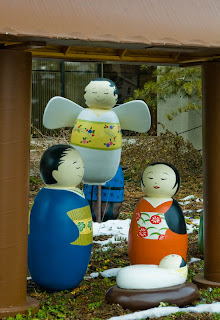
Here are my shots, right now at temple square they have some nativities from around the world, so I took a bunch of shots of this particular one. I think I probably took around twenty. Here are the five I like the best. Which one is better? I don't know it depends on what you like, but I'll tell you my favorite definitely wasn't the first shot I took, or the "walk up" shot. I'll also put my exposure values so you can keep getting used to what they are and what they do. I took these all in aperture priority mode and most of them were at an f/11. The one at f/8 I went lower to get a more shallow dof, usually you won't see that shallow of a dof, but I was using a longer lens, we will have to talk about how lenses affect dof later. Also, like I suggested in exposure, I left my ISO at its lowest setting. Since the lighting was pretty much the same, you'll notice all the settings are pretty much the same.

Setting POV Camera Composition


Composition: f/11 1/60 ISO 200

Setting POV Camera Composition


Composition: f/11 1/60 ISO 200

Setting POV Camera Composition


Composition: f/11 1/60 ISO 200


Setting POV Camera Composition


Composition: f/11 1/60 ISO 200


Setting POV Camera Composition


Composition: f/8 1/45 ISO 200


[read more]

Photography Rules Composition

Aside from exposure composition is probably the most important aspect in photography. If you can't create, yes you need to create a picture it just doesn't happen, something that will grab interest your pictures will always be of the point and shoot variety. When you start learning and using the rules of composition you will add interest to your shots, and when you understand the rules well enough you will know when to break them. Of course rules are made to be broken, but it should be for a specific reason, rather than just on accident.

Some of the rules we are going to talk about have been around long before photography, I'm not an art history buff, so I don't know when they came about. Artists have been utilizing these rules for a long time, and so it was only natural that photography follow these rules as well. If you have taken art classes, I haven't, you may find some of these very familiar, if not, no worries you can learn them now.

I actually found an online version of a Kodak video I watched in my photography class about these rules, and rather than trying to go take my own pictures to show as examples I will just leave a link at the end of each section to the corresponding section in that tutorial, because they already have some great examples. The table of contents, so to speak, of the tutorial can be found here, or you can find the link to the rules of compositions on the side of the blog under the helpful links section.

Simplicity

You've all heard the acronym K.I.S.S., right? Keep it simple stupid. Well this works well for photography as well. The more that is happening in your shot the harder it is for us to know what the subject is. So keeping a shot simple can greatly improve it. Usually the simplicity comes in the background of the shot. There are a couple of ways to keep things more simple, one is using the aperture that you're so good at now, right? If you use a shallow dof, throwing the background out of focus, it makes it easier to pick out the subject and makes the shot more simple. The other is to just use a simple background, don't put your subject in front of something that is really busy, but rather something simple, like a nice blue sky, or a single colored, not too bright, wall. Try to find ways to make the background more simple and our eyes will more easily pick out the subject and your pictures will start being more interesting. This is one of the simplest rules, but it is really powerful.

Rule of Thirds
The rule of thirds is sometimes also known as the golden rule, or golden ratio. The golden ratio side of it might be complicated, but the rule of thirds should be easy to understand. The golden ratio says that if you take a line and divide it into two, the ratio of the shortest segment to the longest segment should be the samePhotography Rules Composition as the ratio of the longest segment to the whole line.


The easy way to look at this in photography is to imagine that your frame is split up into nine equal portions, and you should be trying to place your main subject on the lines or intersections of the lines.
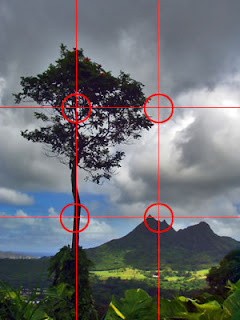
Photography Rules Composition


So in this picture we see the frame divided up by the lines, and the intersections are circled. You should try to get your subject, and other things as well divided into thirds. Notice the branches of the tree are on the top left circle, and the tree itself follows the left line. Also the background is split in thirds, the ground fills up the lower third leaving the sky to fill the upper two thirds. This picture is a perfect example of how to use the rule of thirds.

If you look around you will see this rule in a lot of places, watch TV for example, the eyes are usually placed in the top third of the frame. Nobody is sure why this makes things more interesting to us, but some speculate that the number 3 has some specific meaning to our brains and that is what makes this great.

Another thing to mention, this isn't a rule but I think this is the best section to put it in, is to be careful about leaving enough room in the frame for the action of the shot. So for example if you are taking a picture of somebody riding a bike, and you position them with the front of the bike right up against the edge of the picture this is usually thought of as bad. It is better to leave some room in front of the bike, so the action, or movement, has somewhere to go, so it doesn't make us feel like they are just riding off the frame. The same goes for eyes, if you take a picture of somebody that is looking off, so not straight at the camera, you usually want to leave some room for them to look. Usually thinking about the rule of thirds will help you in these situations, but keep them in mind.

Lines

Lines including shapes have always been used in artistic works. I don't know why they are so effective, but our minds are just mathematically oriented, even if you don't think they are. We see patterns and shapes everywhere without even realizing it. Utilizing this will make your pictures better. One of the best things to use lines for is to lead the viewer to your subject. If there are lines going right to the subject it will help us understand your composition and we will be more interested. Some lines that really add interest are S-curves and C-curves. If you can get something in the shape of an s, hopefully one end is right in the corner of the frame, or a c this really adds interest, again I don't know why, but it does. Another really powerful line is the diagonal line, diagonal lines can really bring out the subject in the photo.

Shapes are also included in this discussion, shapes are important to find. The most common, is the triangle. Think about portraits that you have had taken, especially with three people, the photographer probably tried to create a triangle out of your heads. Geometric shapes in your pictures will just add to the overall composition.

Balance

The tutorial link that will be at the end of this section will talk more about shapes, which goes along more with lines in my opinion, but I see their place here as well. I'm going to talk more about what I see in terms of balance. One of the biggest things I look for in terms of balance is whether or not I could really make two pictures out of the one I just took. For example, if you have four people in the picture paired up in twos, there is a great example of this in the link, then you really could have just taken two pictures, one of each of the couples. If you really want the four together, you need to do something visually so it doesn't feel like two pictures. The other big thing I look for in balance is a way to lead your attention to the subject. So there is a picture in the link with the stone heads, they start out small and get bigger and bigger, until we are at the closest one to us, which is the main subject. Another thing to look for in balance is just to throw things off balance by grouping somethings together and then having another thing by itself, this will really throw the attention to the lone object.

Balance is still one of those areas I need to work on, so I don't recognize it as quickly as I should. The key is that usually symmetry isn't interesting, so making things asymmetrical will usually make your pictures better.

Framing

Although Janae thinks it is cool to have an actual frame in the picture to add interest, you don't need a literal frame to add the concept of framing to your shot. Framing will gives us some bounds and help us to more easily focus on the subject. Think about what a picture would look like on your wall without the frame and matting around it, I bet it wouldn't look as good, and if the background matched your wall it would be hard to tell where the picture actually ended.

When thinking about framing you don't necessarily need all four sides to be framed, even just one side will add interest. Framing is usually done with other objects, trees, bushes, a flag over head, a branch, a wall, anything that will frame your subject will do. I think this is a simple enough concept that I don't need to talk to much about it, just check out the example pictures in the link and you will quickly understand what I mean.

Mergers

No I don't mean company mergers, I mean objects merging with your subject. These are almost always bad. These kind of pictures are always used for a good laugh, if you watch Headlines on Jay Leno you may see him with these types of pictures quite frequently, you know, the one with the guy posing for the camera and behind him on the wall is a moose head, but all you see is the antlers sticking out of the guy's head. Now do you know what I mean? Usually things in the background sticking out of your subject just look bad, or funny, like any rule this can be broken, but you better do it on purpose.

Mergers are also described in the link as being something cut out incorrectly. They have a picture of a big group and somebody on the left is cut halfway off, this is another type of merger you want to avoid. When taking pictures of people try not to cut them out, if you do need to cut parts of them out, don't cut out on joints, knees, wrists, elbows, necks, those are all bad places to cut.

The last merger is just your subject blending in with the background too much. A nice red shirt on a red background will just loose your subject in the background, we will just see a head then some legs, this isn't a good thing.

Most of the time mergers can be avoided simply by moving to the side, or up or down just a little bit. Again, keeping your shot simple will eliminate mergers as well. Another topic that goes along with mergers is just pay attention to what is in your picture, you need to see the whole composition not just the subject, like I said before you are creating the shot, it isn't just there. There are seven places you should always look before you take a picture, and this will really help with eliminating mergers. At first you may have to think about it, but before long your eyes will just always do it and you won't even know it, and it takes less than a second. Always look in the four corners, the foreground, the subject, and the background. Make sure only things you want in the picture are actually there.

Assignment

Okay now its time for your assignment. For this topic I want you to take a picture showing a good and a bad example of each of the first five rules, everything up to mergers. Then I want one picture of a bad example of a merger, it is hard to show a good example of a merger, any picture without one is a good one, so we will just look for a bad one for that last rule. That is eleven pictures, but you're up to it, right? Besides how else will you learn without practicing? Again email me with the pictures or a link to where you posted them so I can link them here for others to see. Oh, and if you're reading this without having done the other assignments, espeically the one with the five shots of the same subject, then go back and do them, no skipping now.

[read more]

ISO Camera setting

Well, it has been a while since I last wrote a post, but not a lot of people are following these anyway, so I don't have a lot of motivation to keep them going. Also I have been more involved with my forum these days too. Although ISO isn't something that I learned until later on, I think it is an important thing to consider. I have put it off thus far because I thought it wasn't too important until you had a good grasp of other things. Now I think I probably should have just covered it after talking about shutter speeds.

What is ISO? It stands for International Organization of Standards. Yes, I realize that would be IOS, but it isn't, so there. This is a group that makes up some standards for different things and they have come up with standards for "film speeds" in photography. People that have been around in the photography world for a long time, probably aren't even reading this because they already know, will also know this as ASA which is what it used to be called.

You have all probably seen this ISO number and not even realized what it meant. Remember when you had those old film cameras and you would buy film and there would be a number on the bottom right corner, something like 100 or 200 or maybe 400. The number would also have a strip of a different color from the box, maybe blue, or green. This was the ISO or film speed that you were seeing. The ISO doubles for each stop of light, so from 100 to 200 is a full stop of light; 1600 to 3200 is a full stop of light. This is important to keep in mind with shutter speeds and aperture values. The values for those settings we covered were also listed in full stops.

So we actually have three things now that determine the exposure in the camera. I promise, there isn't anything else hidden, these three things are all you need to determine the proper exposure.

So what are the different values in ISO doing for exposure? With the other two elements of exposure I mentioned they control two things each, and ISO is no different. ISO first, for exposure purposes, controls how sensitive the film is to light. Well, now it isn't film but your digital sensor. So if you film, sensor, is really really sensitive to light, then it doesn't take very much light to get the information it needs. So the more sensitive the sensor is you can think of it as your sensor getting more light. So this would be the same as slowing down your shutter speed or opening up your aperture. The second thing that comes with ISO is what is called noise in the digital world. Due to the sensor needing to be more sensitive, there is actually more of a charge on your sensor now, and it actually gets hotter too, this will cause some little disturbances in the image that looks like little pieces of grain, and it is called grain, or noise. So the more sensitive your film gets you can now have faster shutter speeds, but you are now going to start getting noisy pictures. So lets look at some values you may see, all cameras are different, but most will have at least 200-800.

50 Lowest sensitivity - less light(requires slower shutter speeds), also less noise
100
200
400
800
1600
3200 Highest sensitivity - more light(can use faster shutter speeds), also more noise

So what do we want to use for our ISO settings? In the earlier exposure posts I said to leave it at the lowest setting you could. The reason for this is because you get less noise. I personally always try to keep my camera set to its lowest setting, 100, and only raise it when I have no other option because I don't want to deal with the noise. Sometimes you just need to raise it to get good pictures though. One good example is when you are inside. If you are in your house taking pictures of your kids, or at a sporting event, you don't usually get a lot of lighting. In most low light situations I just use a tripod so I can just use a longer shutter speed and can keep my ISO at 100, but in situations where you have to keep a high shutter speed, because you want to stop the motion, you can't keep your ISO at 100. Even sports photographers with their lenses that shoot at f/1.4 can't get quite enough light to stop a basketball player with a fast enough shutter speed indoors. So to keep their shutter speed where they want it the option is to raise your ISO. Another time you might want to raise your ISO is for artistic purposes. Janae likes to raise her ISO sometimes when she knows she wants to turn the picture into a B&W. The reason, is because in some cases, especially in some B&W shots, the noise actually adds a cool affect to the picture.

So a quick re-cap. Lower ISO means less noise, but it means you can't use faster shutter speeds, and higher ISO means you can use faster shutter speeds, but you are now getting more noise. We now have 3 things working together to get the correct exposure. As we saw in the other exposure posts, if you have a certain reading you can change any one of the 3 elements to get you more light, as long as you change one of the other 2 to get less light, and you will have the exact same exposure. So for example if the correct exposure is f/11 @ 1/4 ISO 100, you can change one setting to get the most important thing to you in the shot. If the most important thing is to freeze the motion, we can up our shutter speed by 6 full stops to get 1/250 so we can stop the action. Now to get the proper exposure we need to compensate by adding light, so lets lower our f-stop by 4 stops, our lens can open up to an f/2.8, now we still have 2 stops of light we need to gain. So we move our ISO to 400 to gain those two stops of light. We now have f/2.8 @ 1/250 ISO 400 which is the exact same exposure, but now we have a fast enough shutter speed to stop the motion, which was the most important thing for us in this shot, and we have a smaller dof and a higher ISO, which means a little more noise.
[read more]